Sunday, February 20, 2011
Patricia Wells' Leek Tart
It’s slim pickings at the farmers market this time of year so my eyes lit up when I saw a stack of leeks at the Paffenroth Gardens stand the other day. I’m not going to lie; upon closer inspection, the outer layer of the leeks looked a little withered and worse for wear. I bought them anyway because I’d already started dreaming of one of my favorite savory tarts made of leeks, crème fraiche, Gruyere, and prosciutto.
I’ve been making this recipe for years. I love to have it for dinner with a beautiful green salad; it makes me feel so civilized and, well, so French. Which it should because a leek tart is a classic French dish.
The recipe comes from, Bistro Cooking, one of the first cookbooks in my collection. The American author, Patricia Wells, has lived in Paris since 1980 and authored a dozen books, many related to French cooking and cuisine. She also runs a cooking school called At Home with Patricia Wells in both Paris and Provence. Wells wrote a food column for the International Tribune for years and is a true expert on French cooking. Despite her accomplishments (and I haven’t listed them all here) her writing and cooking style remains down to earth and authentic. In my mind Patricia Wells’ recipes are the French equivalent to Ina Garten’s i.e. easy and elegant.
Flamiche aux Poireaux (Leek Tart)
Adapted from Bistro Cooking by Patricia Wells
Paffenroth Gardens, where I found my leeks, is a Union Square stalwart, showing up every Saturday even in the depths of winter. Alex Paffenroth is something of a root vegetable specialist, growing a large and diverse variety all year round.
Leeks are a member of the alluim family, which also includes onions, shallots, scallions and garlic. The flavor of a leek is more sweet and mellow than that of an onion. The edible portion of a leek is the white and light green stalk; the dark green top is fibrous and not pleasant to eat.
Because the white stalk grows under the soil (that’s why it’s white and not green), dirt is usually found between its many layered sections. I remember my cooking school teacher making a big deal about the need to clean leeks carefully before cooking. If a recipe calls for chopped leeks, I find it easiest to clean them by cutting the leeks first than washing them in a colander or salad spinner.
The crust is a classic French pastry dough called pate brisee. It’s light, flaky, and rich and may be used for both sweet and savory dishes (if you’re making a sweet tart, add a little sugar to the dry ingredients). The butter to flour ratio is high which means you need to keep all the ingredients cold and work fast, with as little contact with your warm hands as possible.
The dough is a breeze to make but I guess I wasn’t working very quickly because it didn’t turn out as pretty as it usually does. I’m showing the pictures anyway because I know working with dough can be intimidating for some. I’m here to say it’s not a big deal, especially in this case. The crust gets filled with the leek mixture and no one will ever see the bumps and patches underneath. Go for it!
Pate Brisee
1 - 1 1/4 cups all purpose flour
7 tablespoons unsalted butter, chilled and cut into pieces
1/8 teaspoon salt
3 tablespoons ice water
Place 1 cup of flour, butter, and salt in a food processor. Process just until the mixture resembles coarse crumbs, about 10 seconds. Add the ice water and pulse just until the pastry begins to hold together, about 6 – 8 times. Do not let it form a ball. (As is often the case, I used a pastry blender instead of my food processor; either method is fine). Transfer the pastry to waxed paper; flatten the dough into a disk. If the dough seems too sticky, sprinkle it with additional flour, incorporating 1 tablespoon at a time. Wrap the pastry in waxed paper. Refrigerate for a least 1 hour.
Tart Filling
12 small leeks (about 3 pounds)
4 tablespoons unsalted butter
1 teaspoon salt
Freshly ground black pepper
2 large eggs
1/4 cup creme fraiche
4 slices (about 3 ounces) ham, such as thinly sliced prosciutto, coarsely chopped
1 cup (about 3 ounces) freshly grated Gruyere cheese
Prepare the pastry shell:
Roll out the dough to line a 10 1/2 inch tart pan. Carefully transfer the dough to the pan. Chill for 30 minutes or until firm.
Preheat oven to 425 degrees Fahrenheit.
Prepare the filling:
Trim the leeks at the root. Cut off and discard the dark green portions.
Split the leeks lengthwise then coarsely chop. Wash chopped leeks in a salad spinner or colander with cold water until no grit remains.
Melt the butter in a medium size saucepan over low heat. Add the leeks, salt and pepper to taste and cook, covered, until the leeks are very soft but not browned, about 20 minutes. If the leeks have given up an excessive amount of liquid, drain them in a colander.
Combine the eggs and creme fraiche in a medium size bowl and mix until thoroughly blended. Add the leeks and mix again.
Reserve 1/4 cup each of the ham and the cheese to sprinkle on top of the tart. Mix the rest into the leek mixture.
Pour the leek mixture into the prepared pastry shell. Sprinkle with the reserved ham, and then the cheese. Season generously with pepper.
Bake until nicely browned, about 45 minutes. Serve warm or at room temperature.
Serves 6 - 8
Thursday, February 10, 2011
Axel Vervoordt's farmhouse in Verbier, Switzerland
When it comes to snow I’m a lover, not a hater. The weather we’ve had in New York this winter has kept a smile on my face for months. I look forward to forecasts calling for a foot of snow or even better, make it two! Given that, it’s no wonder I was taken by photos in the February issue of British House & Garden of Axel Vervoordt’s striking home in the Swiss Alps.
Axel Vervoordt, based in Antwerp, Belgium, is respected the world over as an antiquarian and interior designer. He began collecting antiques as a teenager with money loaned to him by his father, a sophisticated man with sophisticated friends, all of whom influenced Axel from an early age. His well-honed eye is drawn to objects from all cultures, continents, and time periods. It’s the mix he is after, as well as authenticity.
It is his desire for the authentic and real that clearly guided him while designing this traditional farmhouse. There is a Japanese term, wabi-sabi, that plays a large role in how Vervoordt selects materials and objects. This ancient philosophy is very interesting…and not easily defined. I found an excellent explanation of it here; a small portion of it reads as follows:
Pared down to its barest essence, wabi-sabi is the Japanese art of finding beauty in imperfection and profundity in nature, of accepting the natural cycle of growth, decay, and death. It’s simple, slow, and uncluttered – and it reveres authenticity above all. Wabi-sabi is flea markets, not warehouse stores; aged wood, not Pergo; rice paper, not glass. It celebrates cracks and crevices and all the other marks that time, weather, and loving use leave behind.
I spend my days working at an interior decorating firm where we create beautiful, fancy interiors (think silk velvet, gilt, and custom everything). I love the graciousness and history of this type of decorating; fancy has its place and I think city living should be more refined, whether your style is modern or traditional. However, if I had a place in the country, this would be more my cup of tea: pared-down, rustic, and functional. Wabi-sabi, I guess…but never knew!
Saturday, February 5, 2011
Creamy Broccoli - White Bean Soup
This soup is so pretty it’s surprising how filling and hearty it tastes. Puréed soups don’t always satisfy me as a main meal but the addition of broccoli florets, pine nuts, and shavings of Parmesan just before serving make this soup more substantial; all I need is a few bites of a good quality whole grain bread and a green salad and I’m set for dinner.
Read any Top 10 Super Foods list and you’re bound to see broccoli on it. Broccoli comes from the nutritionally powerful cabbage family and of all its relatives – cauliflower, Brussels sprouts, kale, and collards – it’s the most potent. In addition to possessing nitrogen compounds known to be effective in preventing some cancers, it is high in fiber, calcium, folate, potassium, iron, and vitamins C, K, and A.
This recipe comes from one of my favorite magazines, Whole Living. Often what I write about on NEL is inspired by something I have read on the the Whole Living pages. The magazine is part of Martha Stewart Living Omnimedia and it shows; the writing is excellent, the photography beautiful and the recipes delicious.
Whole Living is not all about food; there are also articles regarding fitness, beauty, wellness, and eco-friendly living. Best of all, it’s not preachy about its goodness; the articles are approachable and useful in a way that inspires rather than guilts me into living a healthy lifestyle. The recipe for broccoli soup alone is worth the $15 yearly subscription fee!
Adapted from Whole Living
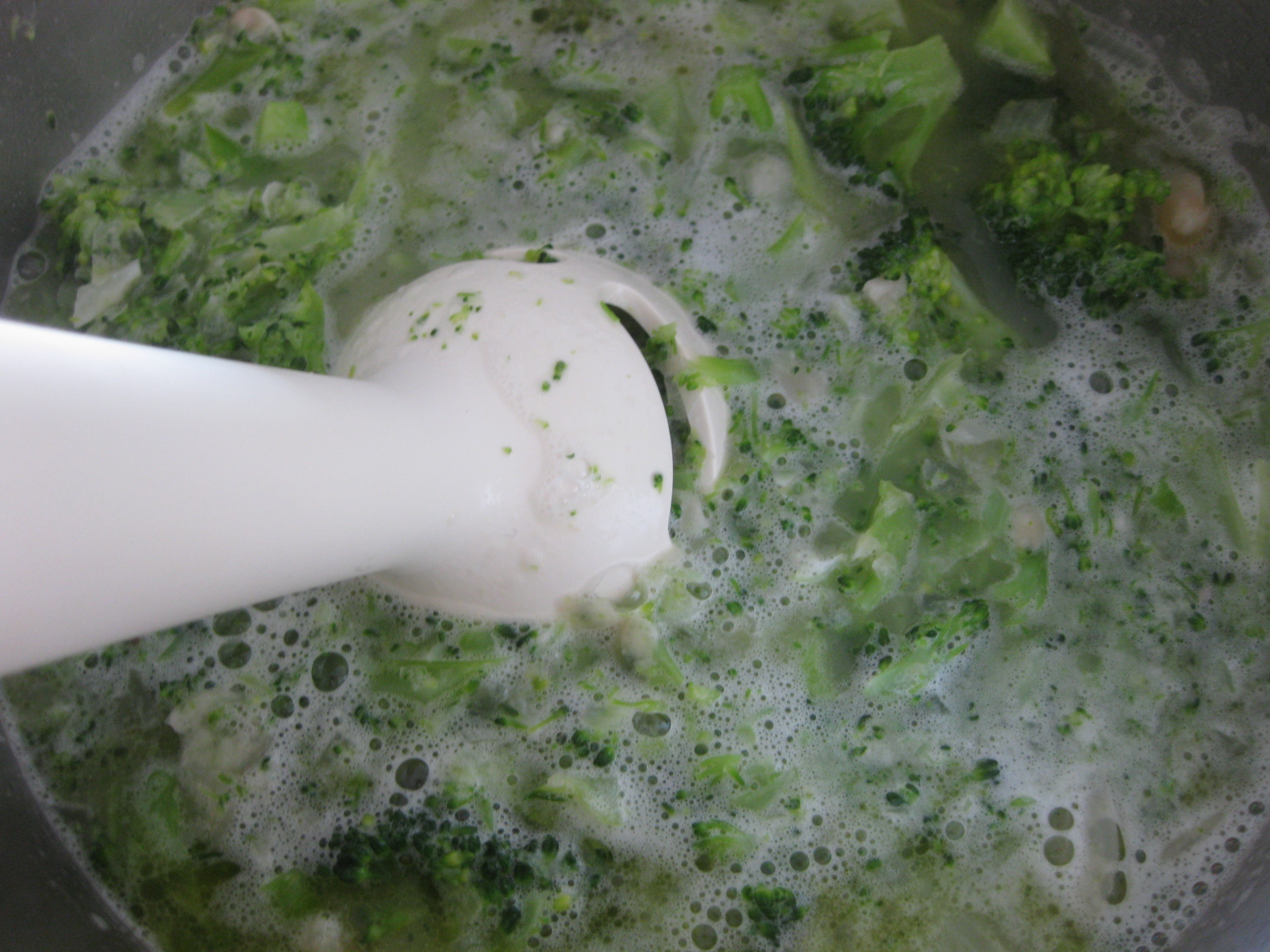
I bought an immersion blender on a whim years ago at Broadway Panhandler and have more than gotten my money’s worth out of it. Is it a kitchen necessity? Definitely not, but it does help make pureed soups more quickly and with less mess.
A piece of kitchen equipment that is a necessity for healthy cooking (and inexpensive to boot) is a steamer. Steaming doesn’t require cooking oil or fat and, and unlike boiling, nutrients don’t leech out into the water. It’s fast, too - broccoli is finished in less than 5 minutes.
1 head broccoli (1 pound), cut into florets, stems thinly sliced
2 tablespoons extra-virgin olive oil
1 medium yellow onion, diced
2 garlic cloves, smashed
1 - 15 ounce can cannellini beans, drained
2 ½ cups chicken stock
Salt and pepper
1 tablespoon pine nuts, toasted
½ ounce shaved Parmesan, for serving
Steam broccoli florets and stems until tender and bright green, about 3 minutes. Let cool slightly. Reserve ½ cup florets for garnish.
Heat oil in a medium pot over medium heat. Sauté onion and garlic until translucent, about 6 minutes. Add beans and stock and bring mixture to a simmer. Remove from heat and add broccoli; puree in batches in a blender or with an immersion blender until smooth.
Season to taste with salt and pepper. Garnish each bowl with broccoli florets, toasted pine nuts, and shaved Parmesan.
Sunday, January 30, 2011
edible Vineyard Beet Chips
It’s taken me a long time to appreciate the beauty and flavor of beets. They might not look like much in their unscrubbed state but their scruffy exterior belies a jewel-like appearance just under the surface. A little cleaning up does a beet wonders.
What most of us think of as a beet is actually the root; the stems and leaves attached to the root are also edible and extremely nutritious. Beet leaves are loaded with vitamins A and C, iron, and calcium. Beetroots are an excellent source of folate, beta-carotene, fiber, manganese, potassium, and betalains, which are known to detoxify the liver.
Raw beets (beetroots, that is) may be grated by hand or in a food processor then added to a green salad or tossed with a simple vinaigrette and made into a salad of its own. If you prefer your beets cooked, take those same grated beets and sauté them on the stove with a little olive oil or butter, salt and pepper.
I’ve come to love roasted beets, served either warm or cold, and have found this Alice Waters' recipe to be an easy, fail-proof method:
1 pound beets
1 teaspoon vinegar (red wine, sherry, or white wine)
Salt
1 – 2 teaspoons extra-virgin olive oil
Preheat oven to 350 degrees Fahrenheit. Trim greens from beet; save for another use. Wash beets thoroughly. Place them in a baking dish with enough water to cover the bottom of the dish to a depth of 1/8 of an inch. Sprinkle with salt, cover tightly, and bake in oven until they are easily pierced with a knife, about 30 – 60 minutes, depending on their size. Uncover and cool. Cut top and bottom of beets and slip off skins. Cut the peeled beets into small wedges and sprinkle with vinegar and salt. Let stand for a few minutes to allow beets to absorb the flavor. Taste and add more salt and/or vinegar as needed. Toss with olive oil and serve.
Every time I make beets this way for my mom she says “These are good but I’d love them with just a little butter on top, nothing else”. We kid my mom that she is a Plain Jane when it comes to food, which she claims is “the English” in her. In truth, I think it sounds like a delicious idea (I’m a bit of a food Plain Jane myself, too – the simpler, the better).
I’ve wanted to make beet chips for a while and last Sunday’s NFL playoff games seemed like an opportune moment to do so. Chips and football are a classic combination. In edible Vineyard’s most recent issue there is a beet chip recipe, which unlike others I have seen, calls for a pinch of cayenne. I liked the sound of that – I love food with a little kick – and decided to give it a go. The recipe was a success but sadly, my hometown Jets were not. That’s all right; I discovered a new recipe to add to my culinary repertoire. Not to mention I’m really a Giants fan, anyway.
Playoff football may be over but Super Bowl Sunday is right around the corner. If you’d like a healthy, colorful, delicious alternative to the ubiquitous potato chip, this is it. I swear it’s just as good as a potato chip, albeit in a different way. You’ll never replace the addictive taste of a traditional fried, salty chip, but the sweet, earthy taste of beets is truly a winner.
Beet Chips
Adapted from edible Vineyard, Harvest 2010
I used my Dad’s fancy mandoline to slice the beets and I’ll be honest, I do not like that thing. I find the whole apparatus not that easy to maneuver, which makes its big, sharp, scary blade even more ominous. My knife skill aren’t so fabulous that I can cut paper thin slices freehand so I was forced to use it anyway. You can be sure the next time I’ll prep the beets with my little hand-held slicer which can be picked one up at any kitchen supply store; I got mine at Muji, a cool Japanese retailer with a nice line of housewares.
The edible Vineyard recipe wasn’t terribly detailed but then again, baking chips is a fairly straightforward thing. Another change I’ll make next time is to forget about brushing each chip with oil as called for in the eV recipe and instead toss them in a bowl with the oil and cayenne. Not only will this take less time, I believe it will give the chips a lighter coating of oil and make for an even crispier chip.
The beet slices shrank quite a bit so don’t be afraid to pack the slices onto the pan in a single layer. I have another recipe that calls for putting the beets on a rimmed sheet pan then stacking another, identical sheet pan on top. This probably helps keep the chips flat but I liked the way mine contorted into twisted shapes. It’s less fussy and less clean up, too.
Red and golden beets
A few teaspoons of olive oil
Pinch of cayenne
Sprinkle of kosher salt
Heat oven to 350 degrees Fahrenheit.
Slice beets thin using a mandoline or any other hand slicer. In a large bowl, whisk olive oil and cayenne. Add sliced beets to bowl and toss to coat slices with oil mixture. Spread beets on a parchment paper-lined baking sheet. Sprinkle with salt.
Bake for about 15 minutes on each side, until crisp. Serve.
Sunday, January 23, 2011
January on Martha's Vineyard...
…is cold. And gorgeous. At least that’s how I would describe it after being there a week ago. The storm that walloped New York City with a foot of snow the day before I left didn’t have the same effect on the Vineyard and instead left a slew of rain with a topcoat of snow. Those several inches of snow quickly froze, turning parts of the island into a skating rink.
The drive up from Manhattan wasn’t bad – about five hours, not including the ferry. For me the ferry doesn’t count as “getting there”; as soon as I’m on board, vacation is on. The sun set while we lumbered to the island and fishermen steamed home for the day.
This innocent looking hill was our first realization that many of the back roads were sheets of ice. I’m not a fan of SUV’s but I have to say this weekend I was grateful for ours and its four-wheel drive!
While my friend took in the view from the comfort of a heated house (and fantasized about golfing in Florida), I ventured out into the chill to explore. I had woods and beaches and goats to see! In the summer this vista is filled with boats either tethered to moorings or under sail to Vineyard Sound; today it was desolate.
I poked around the yard a bit longer
then slipped down the icy road
through the woods
There are many farms of varying sizes on Martha’s Vineyard. This one, called Pilot Hill, was a working dairy until the 1950’s.
The land was purchased by the Vineyard Open Land Foundation, whose mission is to preserve the rural character of the island, and turned into a low-density housing development with many acres of common space. Part of the land is still farmed and provides fresh produce, cut flowers, and eggs in season to its neighbors as well as island restaurants such as The Scottish Bakehouse on State Road.
Walking towards the farm I engaged in a stare down with their cows
but not with these guys…
Across the road reside two of the friendliest goats you’ll ever meet and were they ever happy to see me! I’m guessing they don’t have many visitors this time of year because their heads and ears were clearly overdue for a good scratch. Their winter coats were so pretty, especially this one.
Who knew goats like to nosh on leftover Christmas trees? With every munch the fragrant, wintry scent of pine wafted through the air.
The ladies in the hen house weren’t dumb; they stayed inside, out of the cold!
I had to agree with them at this point. I’d been outside for a few hours and was starting to look forward to a warm, cozy abode of my own. I made my way home, down the deer path.
What next? Food, of course! On Friday afternoons during the winter Offshore Ale Co. is the place to be for their homebrewed beers and $1.00 oysters. I learned on this trip that Bob Skydell, owner of one of the best farm shops on the Vineyard, Fiddlehead Farm, was one of the founders and former owners of Offshore Ale. I definitely like Bob’s aesthetic and eye. At both Offshore Ale and Fiddlehead Farm he has captured the essence of New England without resorting to the cliqued and hokey.
The rustic, soaring interior of this mircrobrewery and pub is filled with beautiful small wooden boats hanging from the rafters as well as racing flags and other boating paraphernalia. A huge barrel of peanuts sits by the front door for anyone to partake in and I was encouraged by the bartender to crack my shells onto the floor, not my plate!
This is the spot I had my first taste of the divine Sweet Neck Farm oysters from Katama. Sweet Necks were available for $2.50 a pop (worth every penny, in my opinion) but in the spirit of the moment, we stuck to the dollar specials, which were Blue Points from Long Island and local West Tisbury Wilds. Offshore Ale brews all their lagers, pale ales, IPAs, and stouts from scratch. I had a fantastic rich, smooth winter ale called Miss Behavin’. When life is good, it’s really good…
The next day was our pilgrim moment. Faced with nothing to eat for lunch but hot dogs dug from the depths of the freezer and neither of us anxious to stand outside by the grill, we opted to roast them in the fireplace. Sitting on the floor with a glass of wine, it was the perfect snack before heading to a friend’s house for dinner in Oak Bluffs.
A few hours before getting on the ferry to begin our trip home we did what people have been doing every morning for decades on the Vineyard – eat at the ArtCliff.
The ArtCliff Diner is a Vineyard institution, a local hangout that is always packed. This is the place where Carly Simon is as likely to be at the table next to you (yes – once) as a local carpenter. We got there just in time and didn’t have to wait for a table, a rarity. But if we had to wait, it would have been well worth it. The ArtCliff’s creative spin on classic country breakfasts, more often than not prepared with food grown locally, is out of this world. Both the atmosphere and staff are easy-going and friendly - the Vineyard at its best.
I had Swiss cheese and ham French toast with poached eggs (I know, I know – but I was starving!)
and my friend had a tomato, cheddar, and spinach frittata on top of home fries.
We shared the best short stack of buttermilk pancakes I’ve ever had. Really.
I’ve never gotten to the end of a stay on the Vineyard and not been sad to go. This trip was no exception. It’s true that most of the shops are closed for the winter so if your idea of fun is shopping, Martha’s Vineyard in January might not be for you. Nor is it for you if you long to be on a beach or a boat in a bathing suit. But if you’re the sort that doesn’t mind dreaming up your own adventures and hanging with the locals – in many layers of clothing! - it could not be more perfect than this time of year.
The drive up from Manhattan wasn’t bad – about five hours, not including the ferry. For me the ferry doesn’t count as “getting there”; as soon as I’m on board, vacation is on. The sun set while we lumbered to the island and fishermen steamed home for the day.
At this point in the road we’re almost to the house.
This innocent looking hill was our first realization that many of the back roads were sheets of ice. I’m not a fan of SUV’s but I have to say this weekend I was grateful for ours and its four-wheel drive!
While my friend took in the view from the comfort of a heated house (and fantasized about golfing in Florida), I ventured out into the chill to explore. I had woods and beaches and goats to see! In the summer this vista is filled with boats either tethered to moorings or under sail to Vineyard Sound; today it was desolate.
I poked around the yard a bit longer
then slipped down the icy road
through the woods
to the beach.
There are many farms of varying sizes on Martha’s Vineyard. This one, called Pilot Hill, was a working dairy until the 1950’s.
The land was purchased by the Vineyard Open Land Foundation, whose mission is to preserve the rural character of the island, and turned into a low-density housing development with many acres of common space. Part of the land is still farmed and provides fresh produce, cut flowers, and eggs in season to its neighbors as well as island restaurants such as The Scottish Bakehouse on State Road.
Walking towards the farm I engaged in a stare down with their cows
but not with these guys…
Across the road reside two of the friendliest goats you’ll ever meet and were they ever happy to see me! I’m guessing they don’t have many visitors this time of year because their heads and ears were clearly overdue for a good scratch. Their winter coats were so pretty, especially this one.
Who knew goats like to nosh on leftover Christmas trees? With every munch the fragrant, wintry scent of pine wafted through the air.
The ladies in the hen house weren’t dumb; they stayed inside, out of the cold!
I had to agree with them at this point. I’d been outside for a few hours and was starting to look forward to a warm, cozy abode of my own. I made my way home, down the deer path.
What next? Food, of course! On Friday afternoons during the winter Offshore Ale Co. is the place to be for their homebrewed beers and $1.00 oysters. I learned on this trip that Bob Skydell, owner of one of the best farm shops on the Vineyard, Fiddlehead Farm, was one of the founders and former owners of Offshore Ale. I definitely like Bob’s aesthetic and eye. At both Offshore Ale and Fiddlehead Farm he has captured the essence of New England without resorting to the cliqued and hokey.
The rustic, soaring interior of this mircrobrewery and pub is filled with beautiful small wooden boats hanging from the rafters as well as racing flags and other boating paraphernalia. A huge barrel of peanuts sits by the front door for anyone to partake in and I was encouraged by the bartender to crack my shells onto the floor, not my plate!
This is the spot I had my first taste of the divine Sweet Neck Farm oysters from Katama. Sweet Necks were available for $2.50 a pop (worth every penny, in my opinion) but in the spirit of the moment, we stuck to the dollar specials, which were Blue Points from Long Island and local West Tisbury Wilds. Offshore Ale brews all their lagers, pale ales, IPAs, and stouts from scratch. I had a fantastic rich, smooth winter ale called Miss Behavin’. When life is good, it’s really good…
The next day was our pilgrim moment. Faced with nothing to eat for lunch but hot dogs dug from the depths of the freezer and neither of us anxious to stand outside by the grill, we opted to roast them in the fireplace. Sitting on the floor with a glass of wine, it was the perfect snack before heading to a friend’s house for dinner in Oak Bluffs.
A few hours before getting on the ferry to begin our trip home we did what people have been doing every morning for decades on the Vineyard – eat at the ArtCliff.
The ArtCliff Diner is a Vineyard institution, a local hangout that is always packed. This is the place where Carly Simon is as likely to be at the table next to you (yes – once) as a local carpenter. We got there just in time and didn’t have to wait for a table, a rarity. But if we had to wait, it would have been well worth it. The ArtCliff’s creative spin on classic country breakfasts, more often than not prepared with food grown locally, is out of this world. Both the atmosphere and staff are easy-going and friendly - the Vineyard at its best.
I had Swiss cheese and ham French toast with poached eggs (I know, I know – but I was starving!)
and my friend had a tomato, cheddar, and spinach frittata on top of home fries.
We shared the best short stack of buttermilk pancakes I’ve ever had. Really.
I’ve never gotten to the end of a stay on the Vineyard and not been sad to go. This trip was no exception. It’s true that most of the shops are closed for the winter so if your idea of fun is shopping, Martha’s Vineyard in January might not be for you. Nor is it for you if you long to be on a beach or a boat in a bathing suit. But if you’re the sort that doesn’t mind dreaming up your own adventures and hanging with the locals – in many layers of clothing! - it could not be more perfect than this time of year.
Subscribe to:
Posts (Atom)